Verify the exact conditions that allow the buyer to recover the deposit.
Review who holds the deposit and the escrow instructions.
Confirm whether the deposit is the seller’s sole remedy if the buyer defaults.
Make sure the agreement clearly explains how termination rights must be exercised.
When you sign an asset purchase agreement to sell your business, you usually stop negotiating with other buyers and begin sharing confidential information about the company. That decision creates risk, because if the buyer later decides not to proceed, you may lose time, opportunities, and leverage in the market.
One way sellers protect themselves from that risk is through an earnest money deposit. Understanding what earnest money is, how it works, and when it may or may not be refundable can help you determine whether your asset purchase agreement properly protects you if the deal falls apart.
Join us to understand what earnest money is and how it protects you as the seller.
Why Sellers Require an Earnest Money Deposit
For you, earnest money is meant to answer a practical question at the beginning of a transaction: Is the buyer serious enough to risk losing the deposit if the deal falls apart?
Consider what happens once you sign an asset purchase agreement with a buyer. The agreement usually requires you to adjust how the business operates while the transaction moves forward.
After the agreement is signed, you generally agree to:
Stop marketing the company • Stop negotiating with other buyers • Share financial records • Allow the buyer to conduct due diligence
If the buyer later decides to terminate the transaction and no earnest money deposit was required, the buyer may walk away without financial consequence. At that point, you may have lost:
Time • Other potential buyers • Confidentiality • Operational stability
For that reason, sellers often require earnest money as a good faith deposit in a business acquisition agreement.
Where the Earnest Money Deposit Is Held
After the asset purchase agreement is signed and the buyer agrees to pay earnest money, the deposit is typically placed into an escrow account rather than delivered directly to you.
The funds are usually held by an independent third party responsible for safeguarding the earnest money deposit until the transaction reaches closing or the agreement allows the funds to be released.
That third party may be:
An escrow agent • A title company • A law firm trust account
The choice of who holds the deposit can affect how the process unfolds, particularly when communication or timing becomes important. The party who selected the escrow holder is often more familiar with how that party operates and how instructions are handled.
If the deposit is held in one party’s law firm trust account, that party may also have a more direct line of communication with the escrow holder. In the event of a dispute, these dynamics can influence how quickly issues are raised, addressed, or escalated.
In most transactions, you will see one of three common arrangements, each with different practical implications:
Seller’s counsel trust account
This structure is more common in smaller or mid-market transactions. If you are the seller, it may provide a greater sense of control or visibility over the process. If you are the buyer, however, you may have concerns about neutrality, even though the law firm is required to follow escrow instructions.
Buyer’s counsel trust account
This is less common but may arise depending on the negotiating leverage of the parties. From the seller’s perspective, this arrangement can feel less comfortable, particularly if a dispute arises and the deposit is being held by the buyer’s counsel.
Neutral third-party escrow (title company or escrow agent)
In larger or more structured transactions, the parties often use an independent escrow agent or title company. This approach is generally viewed as the most balanced, as the escrow holder has no prior relationship with either party and follows defined escrow instructions.
For that reason, the escrow setup is not just administrative. It can affect leverage, communication, and how a dispute unfolds if the transaction breaks down.
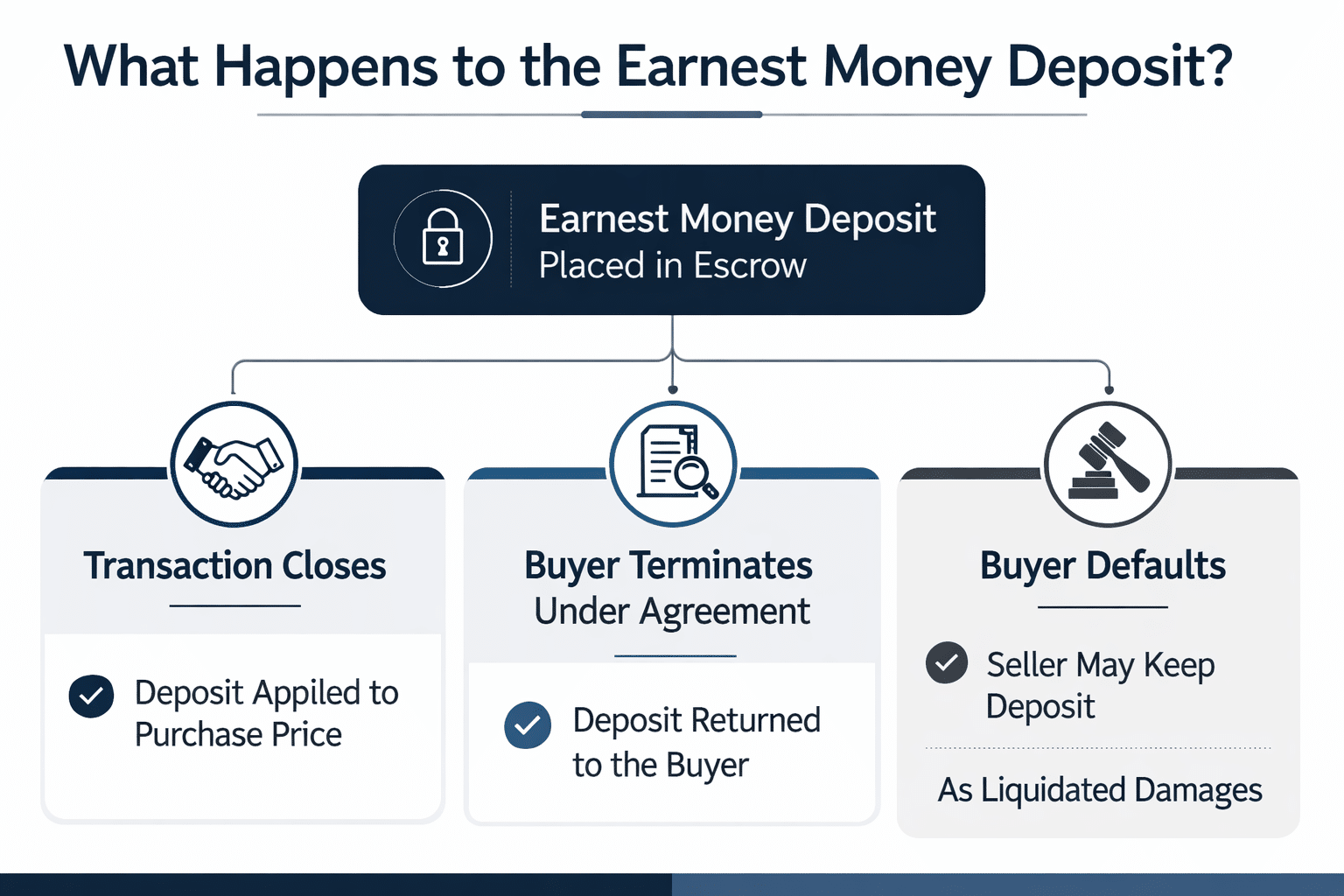
What Happens to the Earnest Money Deposit
When an earnest money deposit is placed into escrow under an asset purchase agreement, the next question is what happens to the money. The answer depends on how the asset purchase agreement addresses closing, termination, or buyer default.
When the Deposit Is Applied to the Purchase Price
If the transaction closes as planned, the earnest money deposit becomes part of the purchase price. The funds are credited toward the buyer’s payment at closing under the terms of the asset purchase agreement.
At closing, the escrow holder releases the earnest money deposit from the escrow account and applies it toward the purchase price. The buyer pays only the remaining balance required by the purchase agreement.
When the Deposit Must Be Returned to the Buyer
The earnest money deposit must be returned to the buyer when the purchase agreement allows the buyer to terminate the transaction under specific conditions. In these situations, the buyer is exercising a contractual right, not breaching the asset purchase agreement.
Common examples include:
A financing contingency fails, and the buyer cannot secure financing
Required regulatory or contractual approvals are not obtained
The buyer properly exercises a termination right under the asset purchase agreement
When one of these conditions occurs, the escrow holder releases the earnest money deposit to the buyer according to the instructions in the agreement.
When the Seller May Keep the Deposit
You may be entitled to keep the earnest money deposit if the buyer refuses to close after the conditions of the asset purchase agreement have been satisfied.
Situations where this may occur include:
The buyer declines to close after due diligence is completed, and no contractual termination right applies.
The buyer cannot complete the purchase because financing was not secured after any financing contingency period expired.
The buyer attempts to withdraw after all required approvals have been obtained.
The buyer fails to proceed to closing even though the seller has satisfied the conditions required under the purchase agreement.
Many agreements address this outcome through liquidated damages language. This provision states that if the buyer defaults without a valid contractual basis, you may retain the earnest money deposit as compensation for the failed business acquisition.
How Deposit Disputes Arise
Situation in the Purchase Agreement
How a Deposit Dispute Arises
The agreement does not clearly state when the earnest money deposit becomes refundable.
The buyer claims the conditions for returning the deposit were met, while the seller claims the buyer defaulted.
The agreement does not specify who decides whether conditions are satisfied.
The buyer asserts a right to terminate the purchase agreement, while the seller argues that the conditions were not met.
The agreement does not explain what notice must be given before termination.
The buyer attempts to terminate the agreement without providing the notice required by the contract.
The agreement does not clearly define termination rights.
The buyer argues that a contingency allows termination, while the seller claims the contingency does not apply.
The agreement does not include clear escrow instructions.
The escrow holder refuses to release the earnest money deposit until both parties agree or the dispute is resolved.
The Questions Your Asset Purchase Agreement Should Answer
A well-drafted asset purchase agreement should clearly address how the earnest money deposit will be handled if the transaction does not close. Clear terms reduce the risk of a deposit dispute and help the escrow holder determine how the funds should be released.
What conditions allow the buyer to recover the deposit? The agreement should clearly define the situations in which the buyer may recover the earnest money deposit.
When does the earnest money become non-refundable? Many agreements allow the buyer to recover the earnest money deposit during an initial diligence period. After that period expires, the deposit may become non-refundable if the buyer refuses to close without a valid contractual termination right.
Who decides whether those conditions are satisfied? The agreement should explain how satisfaction of the conditions will be determined. Some contracts rely on buyer discretion, others require a reasonable determination, while some define objective standards within the purchase agreement.
How must those conditions be proven? The agreement should describe how the buyer must demonstrate that a termination condition exists. Contracts often require written notice, supporting documentation, and compliance with contractual deadlines before the escrow holder releases the deposit.
What happens if the buyer refuses to close? The agreement may state that if the buyer defaults, the seller may retain the earnest money deposit as liquidated damages. This provision compensates the seller if the buyer refuses to complete the business acquisition.
Speak to our New Jersey and New York Business Attorneys Today
If you are preparing to sell your business, your asset purchase agreement should clearly define when the deposit is refundable, when it may be retained, and how disputes are resolved. Our firm advises business owners on drafting and reviewing these agreements to help protect their position before a transaction moves forward.
Are you wondering about any of the issues mentioned above? Please email us at info@wilkinsonlawllc.com or call (732) 410-7595 for assistance.
At Wilkinson Law, we give business owners the clarity they need to fund, grow, protect, and sell their businesses. We are trustworthy business advisors keeping your business on TRACK: Trustworthy. Reliable. Available. Caring. Knowledgeable.®
FAQ
How Much Earnest Money Is Typical in a Business Asset Purchase Agreement?
In many business transactions, the earnest money deposit ranges from about 1 percent to 10 percent of the purchase price, although the amount of earnest money varies depending on the size of the transaction, the level of risk, and how competitive the market is for potential buyers.
When Is the Earnest Money Deposit Usually Paid?
The purchase agreement typically requires the buyer to pay earnest money shortly after the binding contract is signed. In many transactions, the funds must be delivered within a few business days and placed into an escrow account where a neutral third party will hold funds until the agreement instructs that they be released.
Does the Implied Covenant of Good Faith Affect Deposit Refunds?
Even if an asset purchase agreement gives one party discretion to decide whether certain conditions are satisfied, that discretion generally must be exercised in good faith. A buyer cannot rely on a contingency as a pretext to walk away from the transaction without a legitimate basis.
This issue becomes especially important when the agreement allows the buyer to terminate based on subjective judgments, such as whether the results of due diligence are satisfactory.
Can the Earnest Money Deposit Increase During the Transaction?
Yes. Some business purchase agreements require the buyer to increase the earnest deposit after specific milestones are reached, such as the expiration of a diligence period or the removal of certain common contingencies.
What Happens if the Buyer Never Delivers the Earnest Money Deposit?
If the buyer fails to deliver the earnest money deposit when required by the asset purchase agreement, the seller may have the right to terminate the purchase contract. In some agreements, failure to fund the buyer's deposit is treated as a default.
When this occurs, the seller may choose to terminate the agreement and resume discussions with other buyers, particularly if the deposit was intended to demonstrate the buyer’s good faith commitment to the transaction.