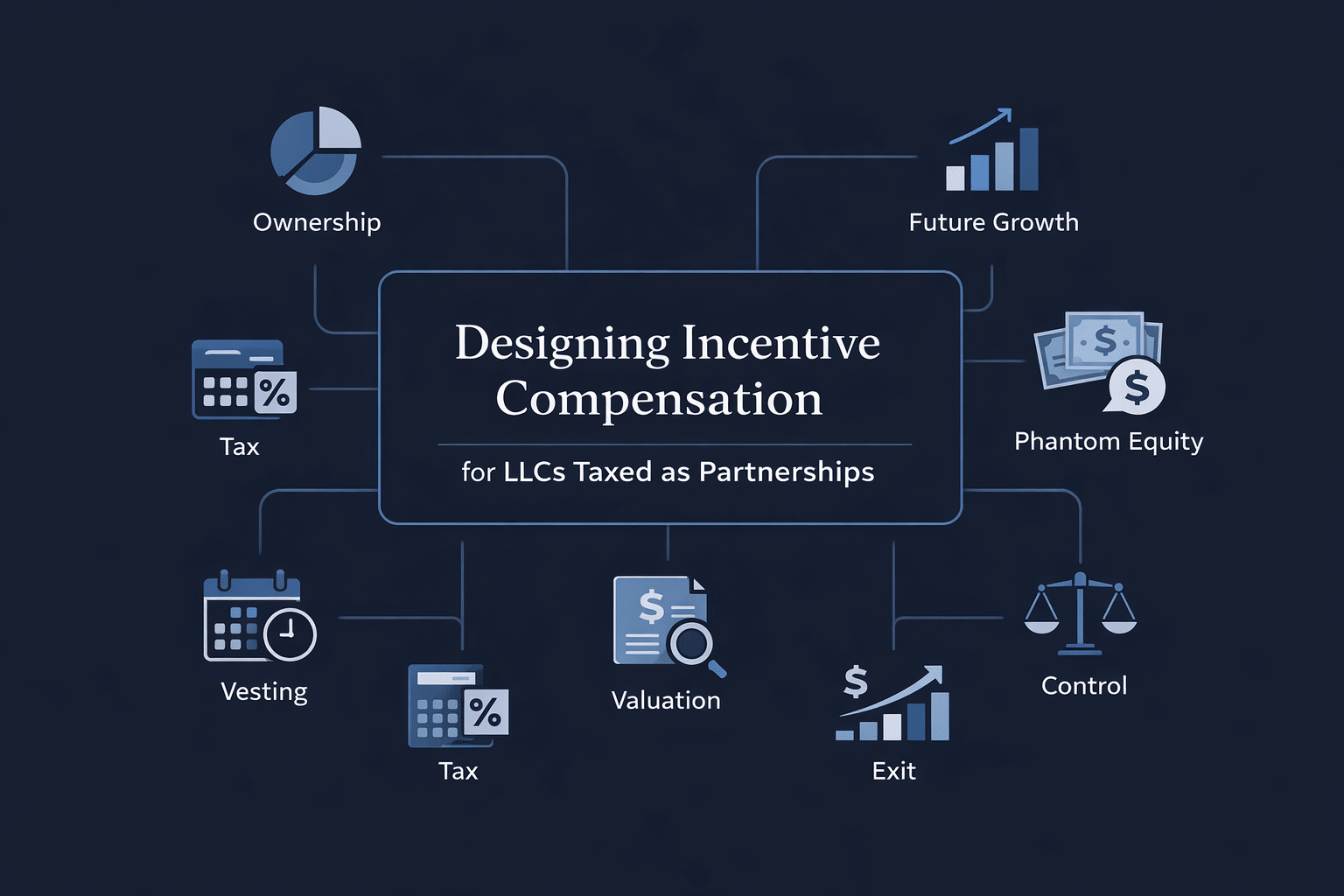
First, identify the real goal. You may be trying to retain a key person, reward performance, support succession, or tie compensation to future growth.
Next, decide whether this person should receive true ownership at all. Many businesses want alignment without changing membership rights or current value.
Then compare the structure carefully. Profits interests, capital interests, and phantom equity do not do the same thing.
Before moving forward, review tax timing, valuation, vesting, and what happens if the person leaves or the business is sold.
The right design can motivate a key contributor. The wrong one can create ownership confusion, tax problems, and cleanup costs later.
Designing Incentive Compensation for LLCs Taxed as Partnerships
If you own a growing LLC taxed as a partnership, there may come a point when salary no longer feels like the right way to reward key employees or other service providers. That is usually where the real incentive compensation question begins.
The issue is rarely whether to pay more. It is whether to structure incentive compensation for an LLC taxed as a partnership in a way that aligns interests without creating tax treatment problems, control issues, or unwanted complications around existing value.
This article explains the steps involved in designing incentive compensation LLCs taxed as partnership. It will help you think through profits interests, capital interests, phantom equity, fair market value, vesting schedules, and the tax consequences that can follow a poorly structured grant.
Step 1: Identify What You Are Trying to Accomplish
This is the point where many business owners need to slow down. Before comparing profits interests, capital interests, or phantom equity, you need to define the goal clearly, because each option solves a different problem in the business.
If you want the person thinking like an owner without immediately sharing current value,profits interests orphantom equity may better fit that goal.
Share existing value now
Capital interests may be part of the conversation when the company is prepared to transfer a real present value stake rather than only future appreciation.
Reward performance without changing ownership
Phantom equity, stock appreciation style arrangements, or othercash-based incentives may work better when you want to keep control and membership interests unchanged.
The incentive can support a longer path toward leadership or ownership transition, rather than serve as a simple reward for current work.
Solve a pay issue without restructuring the company
If the real problem is compensation income or market pay, a bonus or deferred compensation arrangement may fit better than partnership equity compensation.
Avoid moving too fast
A limited first step can make sense when the business is still evaluating the individual, the role, or the tax implications of a later grant.
A business owner asking which option fits the company’s goal is asking the right question. Once the purpose is clear, the next choices around tax treatment, fair market value, and the company’s equity become easier to evaluate.
Step 2: Decide Whether the Incentive Should Involve Real Ownership at All
After defining the goal, you need to decide whether the incentive should change ownership or only create economic alignment. Many businesses want to reward a key person or other service provider without casually creating a partner or altering rights tied to the company’s equity or membership interests.
If you want upside without changing membership rights, phantom equity, or another cash-based arrangement is often a better starting point.
If you want the person to share in future profits without receiving existing value, profits interests may be worth considering.
If you are prepared to give a true stake in current value, capital interests are typically the more direct option.
This decision shapes more than compensation. It can affect dilution, reporting, tax consequences, and how the company handles asale or transition later. A properly structured incentive compensation LLC taxed as a partnership starts with clarity on that ownership question.
Step 3: Match the Structure to the Type of Person You Are Trying to Incentivize
Once you have addressed the ownership question, you need to look at the person in front of you. The right incentive compensation structure depends less on labels and more on the function that person serves in the business.
Someone you want to retain over time may need an incentive tied to continued service.
Someone brought in for targeted expertise may need a more limited economic reward.
Someone being evaluated for future leadership may justify a structure that leaves room for a deeper stake later.
That distinction matters because the same grant does not fit every relationship. Some roles support a stronger case for profits interests or capital interests. Others point toward phantom equity, deferred compensation, or another arrangement that does not alter the company’s equity.
The longer the time horizon, the more ownership-style incentives may come into focus.
The narrower the role, the stronger the case for keeping the arrangement economic only.
The more sensitive the control issues, the more carefully the company should separate upside from true ownership.
A business owner does not need one universal answer here. You need a structure that fits the person, the role, and the level of trust involved, without creating tax consequences or ownership complications you did not intend.
Step 4: Evaluate Tax Consequences Before Finalizing the Structure
After you have matched the structure to the person, you need to look at tax timing with equal care. In incentive compensation LLC taxed as a partnership planning, the hard question is often not whether tax applies, but when it applies.
That timing can affect the company and the recipient in different ways. A grant may raise one set of tax implications at the grant date, during vesting, and another when the holder receives payout, sale proceeds, or similar economic value.
Section 83(b) election may come into play when a partnership interest is issued subject to vesting.
Section 409A may need review where deferred compensation or later payment features are involved.
The tax treatment of phantom equity can differ sharply from that of profits interests or capital interests.
This is one reason partnership-taxed LLCs require their own analysis. Unlikecorporations, they do not fit comfortably into standard equity compensation habits, and the tax consequences can look unfamiliar if the design borrows too much from corporate models.
The structure should be reviewed for tax purposes before final documents are prepared. That gives your business a chance to evaluate federal income tax issues, self-employment taxes, and possible reporting problems while the design is still flexible enough to fix.
Step 5: Determine Whether a Valuation Is Needed
At this stage, many business owners start asking a more uncomfortable question: what number are we actually using? A valuation may matter when the incentive depends on current value, future appreciation, a hurdle amount, or the line between existing value and later growth.
Incentive Structure
How Likely Valuation Is to Matter
Phantom equity
Often important, because the arrangement may depend on appreciation, payout formulas, or a starting value that needs to be measured reasonably.
Profits interests
Often important where the design depends on separating existing value from future growth, even though the valuation question may not look the same as it does with a full present-value transfer.
Capital interests
Usually very important, because the company may be transferring a real current value stake rather than only future upside.
Deferred compensation or bonus tied to value
May become important if payout depends on company value, appreciation, or a threshold amount rather than a fixed cash formula.
Simple cash bonus not tied to value
Usually less important, because the arrangement may not depend on measuring the company’s fair market value at all.
Do not treatValuation as an afterthought. A number that sounds reasonable in conversation may not hold up once you document the grant, review the tax treatment, or later explain how you set the structure in the first place.
Valuation also affects fairness inside the deal. If you start with a number that is too low, you may give away more than you intended. If you start too high, the recipient may get less upside than you meant to offer.
That also affects your tax analysis and your ability to defend the structure later. If the arrangement depends on fair market value, current value, or future appreciation, casual assumptions can create problems when someone leaves, when you sell the company, or when someone later questions the economics of the grant.
Step 6: Build the Vesting and Performance Terms Carefully
Once you choose the structure, you need to decide how the incentive will be earned over time. This is where the grant starts to become real, because the vesting terms determine when the person earns the value and under what conditions.
You can use time-based vesting or performance-based vesting, but they serve different purposes. Time-based vesting usually helps you retain talent. Performance-based vesting focuses on results, milestones, or another outcome you want this grant to drive.
Your vesting terms should answer questions like these:
When does vesting begin?
Will vesting depend on time, performance, or both?
What exactly counts as meeting the performance condition?
Who decides whether the condition has been met?
What happens if the person leaves before becoming fully vested?
Will you allow partial vesting?
Your vesting schedule should match the reason you are making the grant. If you want to retain a key person, a continued-service model may fit better. If you want to reward performance, your vesting requirements should track that goal more closely.
You should also address acceleration and partial vesting directly. If you sell the company, end the relationship with the person, or see only part of a milestone met, silence in the documents can create uncertainty and lead to disputes later.
Step 7: Address Departure, Termination, and Forfeiture Before There Is a Problem
You should decide now what happens if this person leaves. If you wait until there is a resignation, atermination, or a conflict, you will be trying to solve a sensitive ownership and payout issue at the worst possible moment.
A departure before vesting raises one set of issues. A departure after vesting raises another. Before vesting, you need to decide whether that person forfeits everything or keeps something limited. After vesting, you need to address repurchase, redemption, or payout mechanics tied to interests, assets, or liquidation proceeds.
Your documents should state clearly:
What happens to unvested interests
What happens to vested interests
Whether the reason for departure changes the outcome
Whether you have a repurchase or redemption right
How you determine the price
When any payment must be made
You may also want separate rules for different departures. A good-leaver concept usually covers situations like death, disability, or termination without cause. A bad-leaver concept usually covers more harmful exits, including termination for cause or a damaging resignation.
These rules shape bargaining power as much as fairness. They affect what the person can keep, what the company can recover, and how much pressure each side has when the relationship ends. That is why you should draft them before the relationship becomes strained.
Step 8: Think Ahead to a Sale, Succession Event, or Other Major Business Transition
You should design this incentive to work not only while the company stays stable, but also if the business moves into a major transition later. A grant that seems clear today can create friction if ownership, control, or future sale value changes.
A sale can raise several questions at once. You need to decide whether the holder shares in sale proceeds, whether vesting accelerates, and whether you cash out the interest or carry it into the next structure. Those issues should not wait until the deal is already moving.
Your documents should answer questions like these:
Will the holder participate in the sale proceeds?
Does the answer change if the interest is vested or unvested?
Will vesting accelerate if you sell the company?
Can you cash out the interest instead of carrying it forward?
Who decides how the grant is treated in a major business event?
This also matters forsuccession planning. A grant can support a leadership transition, or it can complicate one if it gives the wrong person leverage at the wrong time. That is one reason incentive design should stay tied to future control as well as present needs.
You should address exit treatment at the design stage, not when a sale, succession event, or reorganization is already underway. A properly structured grant can preserve flexibility later, while silence on these points can make a major transition harder than it needs to be.
Step 9: Review the Operating Agreement and Other Existing Company Documents
As your business grows, your documents do not always grow with it. A company may start with an operating agreement built for a simpler stage, then later reach a point where incentive compensation raises questions that the original documents were never designed to answer.
Before you finalize the grant, make sure your operating agreement can actually support the structure you chose. If you are considering profits interests, capital interests, phantom equity, or another arrangement tied to the company’s equity, the governing documents need to fit that design rather than conflict with it.
Speak With Our New Jersey or New York Business Attorneys
Speak with our New Jersey or New York business attorneys if you need help structuring incentive compensation for an LLC taxed as a partnership before you make a grant that affects ownership, tax treatment, vesting, departure rights, or future sale value.
A focused conversation with Wilkinson Law LLC can help you evaluate profits interests, capital interests, phantom equity, and the documents that support them. This can help you move forward with more clarity and reduce the risk of avoidable cleanup later.
Are you wondering about any of the issues mentioned above? Please email us at info@wilkinsonlawllc.com or call (732) 410-7595 for assistance.
At Wilkinson Law, we give business owners the clarity they need to fund, grow, protect, and sell their businesses. We are trustworthy business advisors keeping your business on TRACK: Trustworthy. Reliable. Available. Caring. Knowledgeable.®
FAQs
Can I Use Incentive Compensation if the Person Is Not an Employee?
Yes, possibly. Partnership-taxed LLCs may use incentive arrangements for employees, contractors, advisors, or other service providers, but the tax treatment, documentation, and business risks may differ depending on the relationship. That is one reason the structure should be matched to the specific role rather than copied from a standard compensation model.
Does Giving Someone a Profits Interest Automatically Make Them an Owner for All Purposes?
Not necessarily in the practical sense business owners often assume. A profits interest may create an ownership-style economic interest, but the legal, tax, and governance consequences depend on how the LLC is structured and documented. That is one reason owners should not treat “future upside only” as if it carries no ownership implications.
Do I Need to Update the Operating Agreement Before Granting an Incentive?
Often, yes. If the arrangement touches equity rights, allocations, vesting, repurchase rights, transfer restrictions, or sale treatment, the operating agreement and related company documents may need revision. A grant that does not fit the governing documents can create confusion or conflict later.
What Happens if the Person Leaves Earlier Than Expected?
That depends on how the arrangement is designed. One of the most important planning questions is what happens to unvested rights, vested rights, payout rights, and repurchase rights when the relationship ends. If those rules are vague, departure can become the moment when the business first realizes the structure was incomplete.