Here's an engaging story inspired by a true case to answer a key question for successful business owners:
Can you lose a business lawsuit against your partners even if you know they clearly harmed you?
The Hardest Part of a Business Lawsuit
May Be Proving the Loss
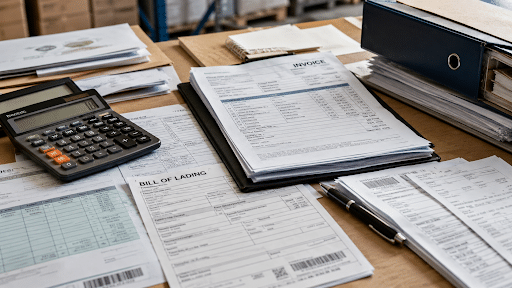
Business lawsuit damages often depend on records that show what was lost, what caused the loss, and how the amount was calculated.
By 7:12 on a Monday morning, Eddie Romano was already standing in the parking lot of his warehouse in Edison, New Jersey, holding a cup of coffee that had gone cold.
The truck was supposed to be there at 6:30.
It was not a small truck either. This was a full container of specialty food products his company, Garden State Global Foods, had spent months arranging. Mango pulp. Lentil snacks. Frozen breads. The kind of inventory that kept independent grocery stores calling before their own customers started complaining.
Eddie checked his phone again.
No update.
Then his warehouse manager, Luis, walked outside with the careful expression people use when they are about to ruin your morning.
“Boss,” Luis said, “you’re not going to like this.”
That was never a promising sentence.
According to Luis, the shipment had not vanished. It had arrived in New Jersey and simply gone to another warehouse.
Not their warehouse.
The other warehouse belonged to a new company started by Eddie’s former business partner, Martin D’Souza, who had resigned from Garden State Global Foods two days earlier with a handshake, a tight smile, and the classic line: “I just need a change.”
Apparently, the change required 40,000 square feet and Eddie’s shipment.
Eddie did what most business owners would do. First, he stared at Luis. Then he said several words that would not survive review by the HR department. Then he called his lawyer.
At first glance, Eddie felt like he had the case of the century.
Martin had been inside the company for years. He knew the suppliers. He knew the customers. He knew which grocery chains paid quickly, which ones haggled over every invoice, and which buyer always asked for a “small favor” right before Diwali season.
Worse, Eddie believed Martin had been quietly building competing companies while still involved in Garden State Global Foods’ operations. Some customers seemed to drift away right after Martin had access to pricing, vendor lists, and import schedules.
To Eddie, the story was obvious.
“He took the business,” Eddie told anyone who would listen. “He took the customers. He took the shipment. What else does the court need?”
The answer, unfortunately, was not comforting.
The court needed proof.
More specifically, Eddie needed to prove what damages the company suffered and how those damages were calculated.
That is where things began to wobble.
Eddie had emails. He had angry texts. He had invoices that made his blood pressure rise. What he did not have was a clean, reliable damages calculation showing how much money the company lost because of Martin’s conduct.
How many sales or opportunities were actually diverted?
Which customers left because of Martin, rather than price, timing, inventory shortages, or the usual chaos of the food distribution business?
What were the lost profits after subtracting costs?
What was the value of any lost goodwill?
How much of the claimed loss belonged to the company, and how much belonged to Eddie personally?
These were not questions Eddie could answer by pointing at a spreadsheet and saying, “Look at it. It’s right there.”
The case needed an expert who could connect the dots in a way a court would accept. The expert needed to explain the numbers, the documents, the method, and the reasoning. Instead, Eddie’s damages proof arrived late, thin, and shaky. When challenged, it could not carry the weight of the lawsuit.
Eddie then tried to fix the problem by bringing in a better expert. But by then, the litigation clock had run down. Discovery was over. Trial dates had been set. The other side had already spent time and money responding to the first expert.
The judge was not interested in rewinding the movie.
So Eddie found himself in the most frustrating position a business owner can imagine: he still believed he had been wronged, but his case could not get to trial because he could not prove damages in the way the law required.
That is the part business owners should pay attention to.
Takeaways for Business Owners
In business litigation, being right about what happened is not always enough. A court still needs admissible evidence showing what the harm was, what caused it, and how the amount was calculated.
A missing shipment may start the fight.
A bad partner may explain the anger.
But in court, the numbers have to survive scrutiny.
This story is based on a real court case, with names and details modified for clarity and confidentiality. The legal principles remain the same, providing important lessons for business owners facing similar situations.
Are you wondering about any of the issues mentioned above? Please email us at info@wilkinsonlawllc.com or call (732) 410-7595 for assistance.
At Wilkinson Law, we give business owners the clarity they need to fund, grow, protect, and sell their businesses. We are trustworthy business advisors keeping your business on TRACK: Trustworthy. Reliable. Available. Caring. Knowledgeable.®



