Here's an engaging story inspired by a true case to answer a key question for successful business owners:
If your litigation settlement sounds final, but leaves room for argument,
can you be sued again over the same basic dispute?
When You Don’t Have the Time or Money to Make It Clear,
Litigation Will Surely Bite You in the Rear!
In Newark, Samir Patel ran a software company that helped small businesses manage scheduling, billing, and customer records.
His clients were salons, repair shops, medical offices, and the kind of family businesses where one missed login could ruin somebody’s whole afternoon.
He was not a dramatic man. He liked subscriptions that renewed on time, support tickets that stayed reasonable, and merchants who did not email him at 11:48 p.m. with the subject line “Quick question.”
Then he got sued.
It started with a group of merchants who claimed Samir’s company had charged monthly fees they had not clearly agreed to.
Some said the pricing had changed midstream. Others said the statements were vague enough to require interpretation, which is not a service most customers enjoy doing for themselves.
Samir read the complaint twice at his desk, then once more in his car, as if the parking lot might improve the wording. It did not.
The case dragged on long enough to become part of his routine. Calls with lawyers slipped between payroll and product meetings.
He signed papers he barely had time to read. He learned that “circling back” is apparently a phrase used by every profession when nobody has good news.
By the second year, Samir was done. Not legally done, emotionally done.
When the other side offered a settlement, he took it. He paid more than he wanted, less than they demanded, and told himself that was the adult version of winning.
The agreement was dense, full of broad release language about claims that had been raised, could have been raised, or might somehow arise later, and about the company’s right to change its fees.
At the time, it sounded final enough to let a person sleep again. Years later, it would sound final enough for both sides to fight over what “final” was supposed to mean.
For a while, it worked.
He stopped flinching when his phone rang with an unknown number.
He took his wife to dinner.
He even joked once that he had become the kind of businessman who settled litigation before lunch.
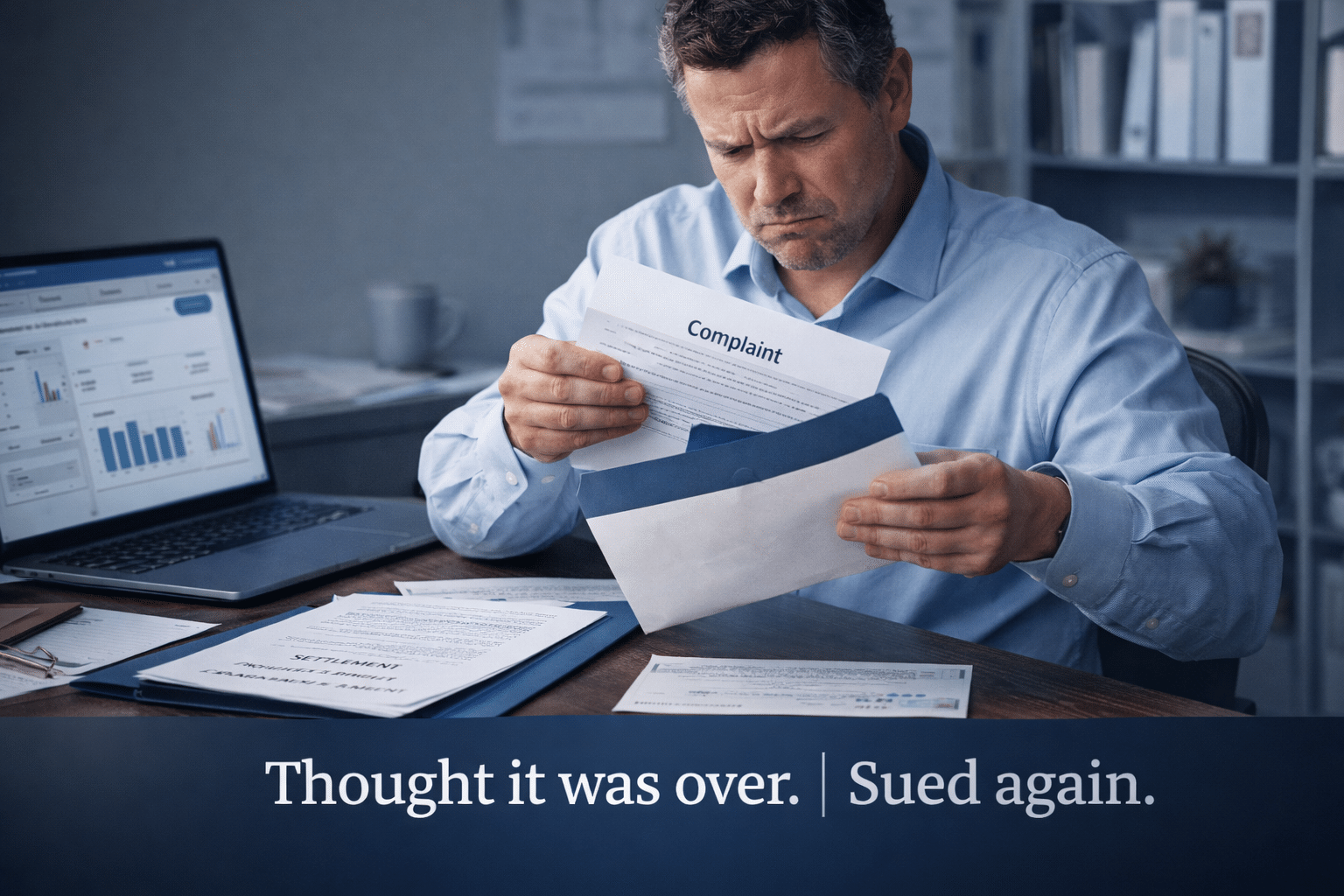
Then, nearly three years later, another complaint arrived.
Samir stood in his office holding the envelope with the same expression people wear when the waiter brings a bill they already paid for.
His operations manager walked in, saw his face, and quietly backed out without asking anything.
The new complaint was not from the same people, which somehow made it worse.
Different merchants, same kind of grievance.
They claimed Samir’s company had kept charging fees they never clearly approved, or had changed the fee structure after the settlement in ways that reopened the same old fight.
New dates. New invoices. New names at the top of the complaint.
To Samir, it felt like the first lawsuit had simply gone out and found a sequel.
He called his lawyer before he finished reading it.
“Tell me this is garbage,” he said.
There was a pause.
Samir had come to hate that pause. It was the pause of a man arranging expensive words into a careful sentence.
His lawyer finally said, “I think we have a strong enforcement argument.”
Samir leaned back in his chair. “That is lawyer for ‘this is not garbage,’ isn’t it?”
“It is lawyer for ‘I would not ignore it.’”
So back they went, not to retry the old case, but to fight over what the settlement had actually done.
Samir’s side argued that the whole point of paying good money years ago was to end this exact kind of fight.
The judge agreed. The old settlement, the court said, barred the new claims.
Samir left that day feeling almost cheerful, which made him immediately suspicious of himself.
He bought everyone lunch. He answered two emails with exclamation points. He told his wife that evening, “It turns out closure is real.”
Then the appeal landed.
The higher court did not say Samir was wrong. It said the settlement language was muddy enough that the fight was not over.
One part of the agreement sounded broad enough to wipe out future claims.
Other parts sounded tied to claims that already existed back then.
That was enough to send the whole thing back for a deeper hearing on what the parties had meant when they signed it.
That was when Samir felt the real regret.
Takeaway for Business Owners
So dear business owners, remember: A settlement does not just end a lawsuit. It defines what peace actually means. If that definition is muddy, you may end up litigating the settlement itself.
Instead of learning that the hard way, like Samir did, make sure the agreement clearly states what claims are being released, whether future claims are included, and whether similar disputes can come back later under a different name.
This story is based on a real court case, with names and details modified for clarity and confidentiality. The legal principles remain the same, providing important lessons for business owners facing similar situations.
Are you wondering about any of the issues mentioned above? Please email us at info@wilkinsonlawllc.com or call (732) 410-7595 for assistance.
At Wilkinson Law, we give business owners the clarity they need to fund, grow, protect, and sell their businesses. We are trustworthy business advisors keeping your business on TRACK: Trustworthy. Reliable. Available. Caring. Knowledgeable.®