Here’s an engaging story inspired by a true case to answer a key question for successful business owners:
Could the sentence that helps you close a sale also be the one that opens the door to a dispute?
The Oven That Was “Working Perfectly”
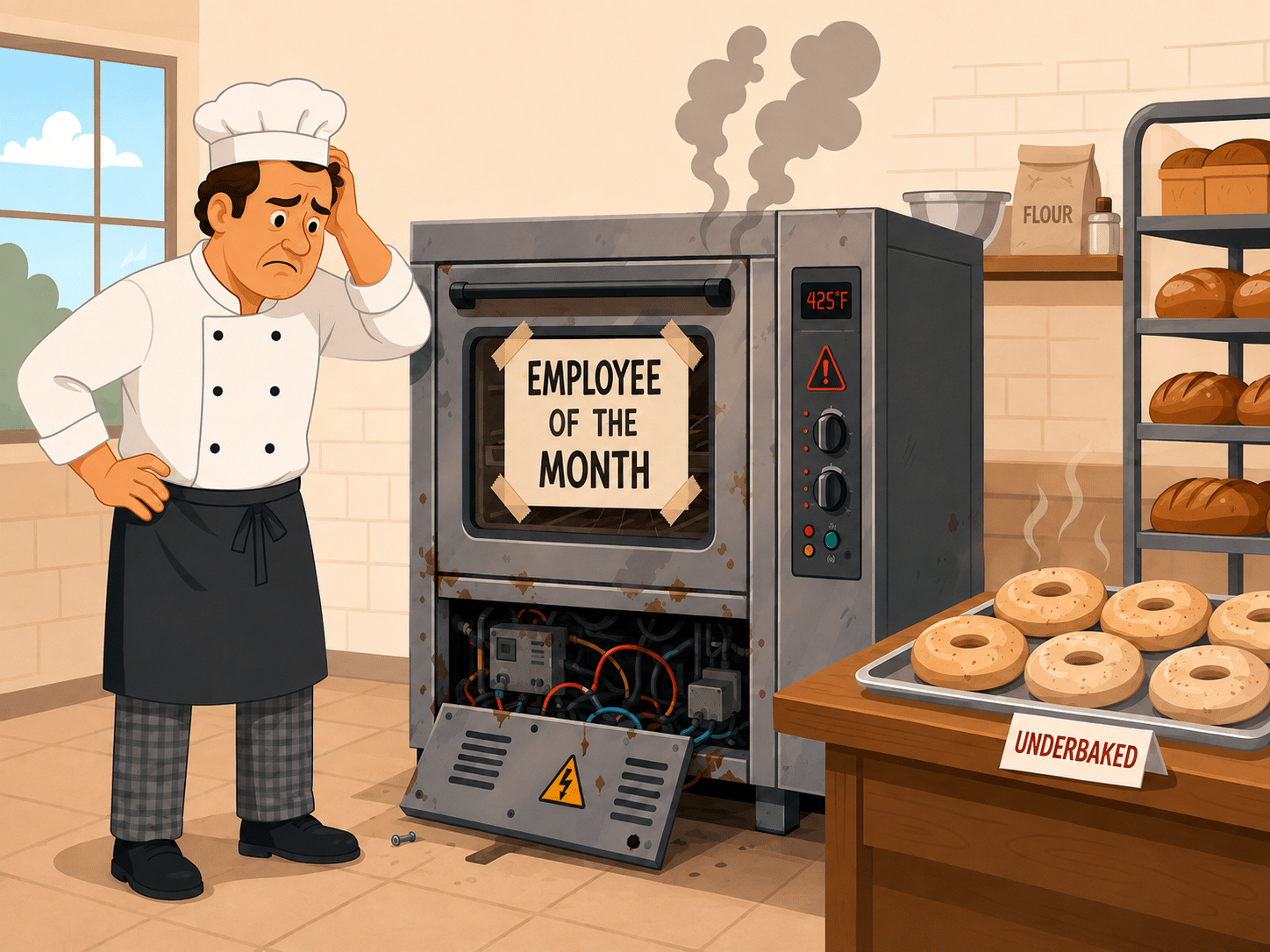
The bakery’s used commercial oven displayed 425 degrees but failed to bake the bagels,
despite the seller’s claim that it was fully operational.
At 4:42 on a Tuesday morning, the new oven at Maple & Main Bakery in Morristown displayed a confident 425 degrees.
Inside, two dozen bagels remained pale and doughy.
Frank DeLuca stared through the oven door. His head baker, Rosa, stood beside him holding a timer.
“Maybe they need another five minutes,” Frank said.
“They’ve had thirty.”
“So, another ten?”
Rosa opened the door and held her hand near the heat.
“I’ve had warmer handshakes.”
Three weeks earlier, Frank had been thrilled about the oven. Maple & Main had just signed a contract to supply breakfast pastries to two local hotels. The bakery’s existing ovens were already running from before sunrise until early afternoon. Frank needed more capacity, but a new commercial oven cost more than he wanted to spend.
Then he found a used one at a restaurant-equipment dealer in Clifton.
The salesman, Gary, described it as a “real workhorse.” It had a few scratches, he said, but nothing that affected performance.
Frank drove up to see it. The oven was enormous, stainless steel and imposing — the kind of machine that looked capable of baking six hundred dinner rolls while doing your taxes.
Gary handed him the sales agreement.
At the top, in bold capital letters, it said:
EQUIPMENT SOLD AS IS. NO RETURNS. NO REFUNDS.
Frank understood. It was a used oven, not a puppy. He was willing to accept some wear.
Farther down, however, the agreement included another statement:
The oven has been inspected by a qualified commercial-appliance technician and confirmed to be fully operational.
That settled it. Frank paid $18,500 and arranged delivery.
Now the oven was taking up six feet of kitchen space and producing warm dough.
Frank called Gary.
“Did your technician test this oven?”
“Of course,” Gary said. “It was working when it left here.”
“Do you have the inspection report?”
There was a pause.
“I’ll have to check the file.”
The file apparently required an archaeological expedition. A week passed. Then another. Frank received no report, no technician’s name, and no explanation of what had actually been tested.
He did receive several reminders that he had purchased the oven “as is.”
Frank hired his own technician. The technician removed a panel, looked inside, and made the quiet whistling sound tradespeople make shortly before delivering expensive news.
The temperature control system was failing. Replacement parts were no longer readily available. Repairing the oven, if the necessary parts could be found, might cost nearly as much as Frank had paid for it.
For the next several months, the oven stood unused near the back wall. Staff members placed cooling racks on top of it. Someone taped a handwritten sign to the door:
EMPLOYEE OF THE MONTH
Frank’s attorney eventually contacted the equipment dealer. Gary again pointed to the “as is” clause and the no-refund language.
But those provisions were only part of the agreement.
When the dispute reached court, Gary could not produce an inspection report. He could not identify the supposedly qualified technician. Under questioning, he acknowledged that a warehouse employee had plugged in the oven and confirmed that the display turned on.
The judge was unimpressed.
The bakery had accepted the usual risks of purchasing used equipment. The agreement did not promise that the oven was new, free from scratches, or guaranteed to work forever.
But Gary had made a separate, specific promise: a qualified technician had inspected the oven and confirmed that it was fully operational.
A glowing display was not that inspection.
Frank recovered the purchase price and his related expenses. The oven finally left Maple & Main, much to Rosa’s disappointment.
“We’re losing our best cooling rack,” she said as the movers wheeled it out.
Takeaway for Business Owners
Gary thought “as is” ended the conversation. It did not. The sentence he added to close the sale, the promise of a professional inspection, was the sentence that cost him. The lesson for business owners is simple: boilerplate cannot protect a promise your business cannot prove.
This story is based on a real court case, with names and details modified for clarity and confidentiality. The legal principles remain the same, providing important lessons for business owners facing similar situations.
Are you wondering about any of the issues mentioned above? Please email us at info@wilkinsonlawllc.com or call (732) 410-7595 for assistance.
At Wilkinson Law, we give business owners the clarity they need to fund, grow, protect, and sell their businesses. We are trustworthy business advisors keeping your business on TRACK: Trustworthy. Reliable. Available. Caring. Knowledgeable.®



