Here’s a story inspired by a real case to answer two important questions for business owners:
Can ignoring a contract dispute make it go away,
or just make the problem worse?
And
If the other side gets the paperwork wrong,
can you afford to treat the dispute as their problem?
A Bad Address Doesn’t Make a Claim Disappear
When Rachel walked into Tom Levin’s office with the certified envelope, he was eating lunch over a stack of purchase orders.
“Another one came back,” she said.
Tom looked at the envelope.
“Wrong address?”
“Old office.”
Tom smiled and went back to his sandwich.
Levin Office Supply had moved out of that building in Yonkers almost two years earlier. The old place now belonged to a physical therapy practice. Somewhere between the post office, the former landlord, and whoever maintained mailing records, important-looking envelopes still occasionally tried to find Tom there.
Usually, it was annoying.
This time, it felt useful.
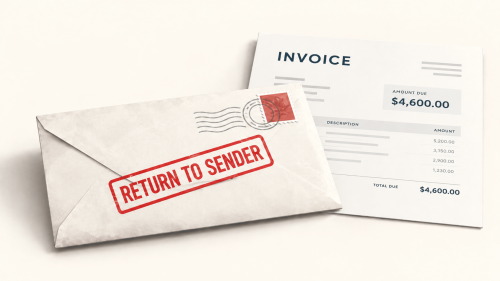
A few weeks earlier, Tom had received a $4,600 bill from Aaron Price, a lawyer he had hired briefly to help with a business dispute.
The engagement had lasted only six days, and Tom could not understand how Aaron had managed to bill twenty-three hours in that time. Aaron, for his part, said the work had been done and expected to be paid.
Aaron began trying to collect, but the process was messy. Notices went to the old address, mail came back, and other attempts at delivery did not go smoothly.
Tom noticed every mistake, and before long, those mistakes seemed almost as important to him as the bill itself.
“If he can’t even send the papers to the right place,” Tom told Rachel, “how exactly is he going to make me pay him?”
Rachel stopped sorting the afternoon mail.
“That sounds like two different questions.”
Tom looked at her.
“What does?”
“Whether he sent the papers correctly and whether you owe him the money.”
Tom waved a hand.
“That’s why you’re not a lawyer.”
For Tom, though, the distinction did not seem especially important. The paperwork was wrong, and that felt like leverage.
Then the dispute reached court.
By then, nobody had to wonder whether he knew about the dispute. He was standing in the room with the lawyer who wanted $4,600 from him.
Tom was formally given notice of his right to have the fee dispute decided through arbitration.
He chose arbitration.
Arbitration finally put the underlying question squarely on the table:
Was the $4,600 bill actually owed?
Tom argued that the bill was too high and questioned how Aaron could have spent twenty-three hours on the matter in just six days. Aaron explained the work he had done and how he had arrived at the amount.
The arbitrators sided with Aaron and awarded him the full $4,600.
Tom challenged the decision, but the result did not change.
That brought him back to something he had been thinking about since the dispute began: the problems with the paperwork. Notices had gone to the wrong address, mail had been returned, and service had not gone smoothly.
If the case had not started properly, Tom argued, how could the judgment at the end of it stand?
But the court looked at more than what had happened with the first few mailings. By then, Tom clearly knew about the claim. He had appeared in court, chosen arbitration, argued his position, and challenged the decision when it went against him.
Whatever problems there had been with notice or service at the beginning, they had not kept Tom from understanding the dispute or having the opportunity to defend himself.
The judgment stood.
A few days later, Rachel found Tom at his desk reviewing the company’s accounts payable report.
She dropped a vendor invoice in front of him.
Tom looked at it.
“Is this ours?”
“Correct company. Correct address. Correct amount.”
He glanced up.
“You seem pleased with yourself.”
“Just trying to eliminate your procedural defenses.”
Tom laughed despite himself and picked up the invoice.
This time, he read it.
Takeaway for Business Owners
So, dear business owners, when a contract dispute arises, deal with the claim itself. A bad address, failed delivery, or another procedural defect may matter, but do not count on it to make the problem disappear. The paperwork can be wrong and the dispute can still be very much alive.
This story is based on a real court case, with names and details modified for clarity and confidentiality. The legal principles remain the same, providing important lessons for business owners facing similar situations.
Are you wondering about any of the issues mentioned above? Please email us at info@wilkinsonlawllc.com or call (732) 410-7595 for assistance.
A Wilkinson Law, we give business owners the clarity they need to fund, grow, protect, and sell their businesses. We are trustworthy business advisors keeping your business on TRACK: Trustworthy. Reliable. Available. Caring. Knowledgeable.®